Chapter 14
Now We Can See the Whole System
Each preceding chapter has isolated one dimension: warmth, hierarchy, structure, adaptation. That is a useful way to explain a phenomenon and a false way to describe a shift. The experience of an immigrant service worker is not made of individual dimensions. Collectivism, power distance, uncertainty avoidance and acculturation interact simultaneously in every service encounter.
The framework that follows puts them back together. It presents no new theory. It integrates existing theoretical resources — Hofstede’s cultural dimensions, Berry’s acculturation model, the SERVQUAL dimensions — and places them in the situation of the fourteen participants. Its premise is that service quality is a continuum shaped by culture, organization and relationship, rather than a fixed construct measured against universal standards.
Acculturation sits at the centre, because it is the process through which cultural orientations are negotiated and realized in service delivery. Six interconnected components shape it.
Heritage cultural orientations — collectivism, power distance, uncertainty avoidance — describe the general predispositions participants held when they arrived in Canada. These orientations shape, but do not determine, the initial service behaviours they described: interpersonal warmth, deference to authority, a preference for structured procedure.
Organizational context — management attitudes, training practices, workplace policies — conditions how much room exists for cultural expression. This is the Arab owner who understands the offered tea and the Canadian supervisor who sees it slowing the line, both in the same restaurant.
Acculturation itself, in Berry’s sense, is the dynamic negotiation between heritage orientations and Canadian service norms. Not a single event. A selective process, run continuously.
Visible service behaviours are what emerges from that negotiation — the observable outcomes in the workplace, measurable against the SERVQUAL dimensions and shaped by customer expectations.
Customer perception completes it, because service quality is ultimately co-created in the interaction between provider, customer and organization.
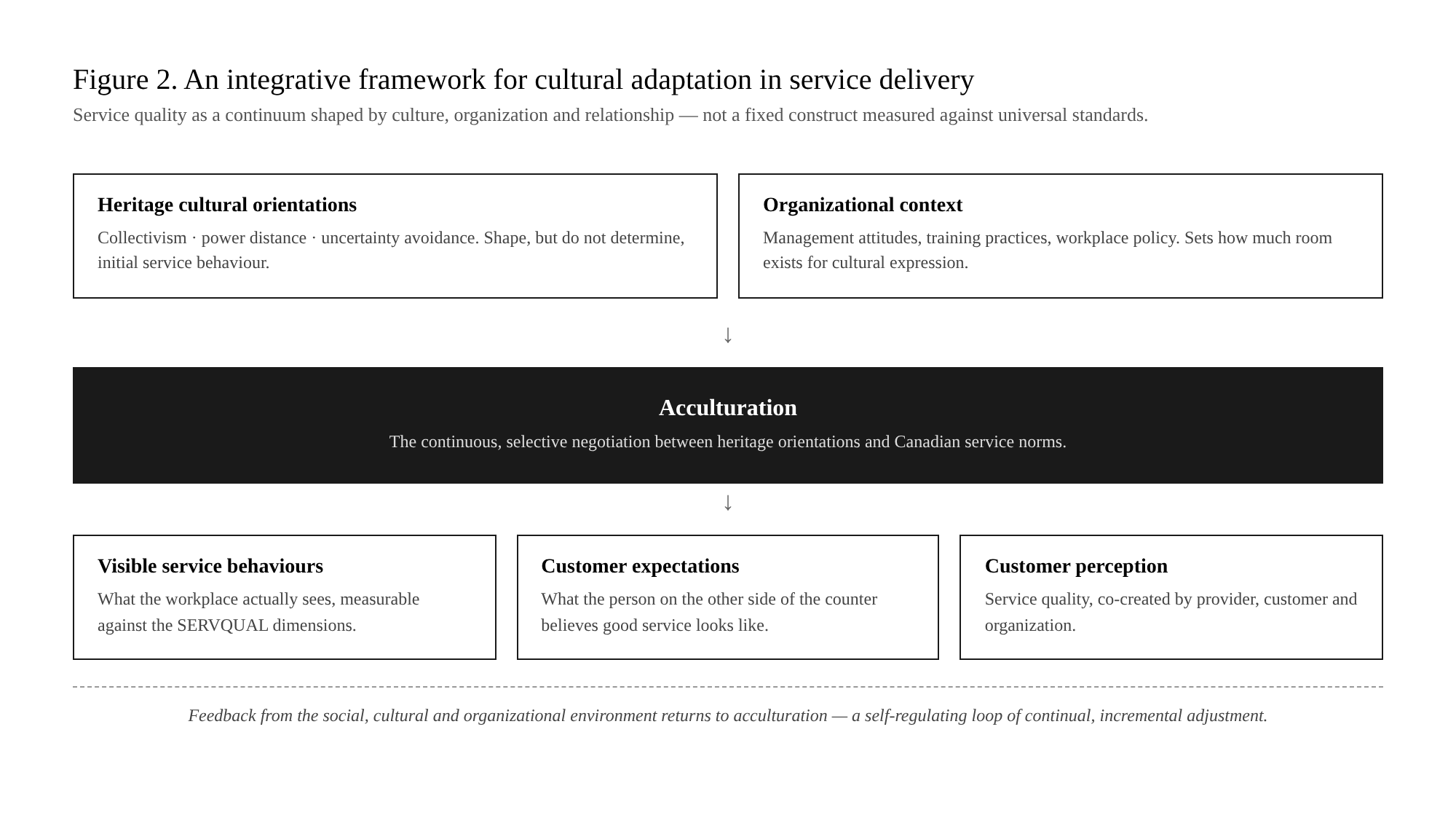
Three patterns emerged from the data about how this system behaves.
First, acculturation operates on a fluid, continuous spectrum rather than as a binary or fixed state. It is a process of constant adaptation, not a location a person arrives at.
Second, it is driven by a constant flow of feedback from the surrounding social, cultural and organizational environment. That feedback is the catalyst for change — an uncomfortable customer, a colleague’s remark, a comment card, a manager pulling someone aside.
Third, that feedback produces continual, incremental changes in behaviour, attitude, and self-perception. It is a self-regulating loop: continuous feedback producing continuous adaptation.
Taken together with the four themes, the framework establishes one conclusion. Arab cultural values do not serve as barriers to service quality in the Canadian setting. They are assets. Collectivist warmth enhances empathy and responsiveness. Deference to authority produces attentiveness and reliability under direction, which can be channelled constructively. The need for structure produces consistency, given proper support. Selective acculturation preserves those strengths while enabling adaptation. A supportive organizational climate reinforces the cultural assets — warmth, hospitality — while reducing the friction, such as cross-cultural misunderstanding or perceived inefficiency.
Service quality, in short, is created in the space between customer, provider and organization. Which means that every party in that space can improve it, and every party can damage it.
Including, increasingly, a party that is not human at all.