Chapter 9
Culture Is Not a Country
Everything in this book so far has leaned on a set of numbers. It is time to look at them properly, and then to be honest about what they cannot do.
To understand what a phrase like “Arab cultural values” actually contains, I compiled Hofstede’s dimensional scores for the Arab League’s member states and weighted them by population. Data exist for eleven of the twenty-two states — together about 62% of the region’s people. The result is a profile:
| Dimension | Population-weighted score |
|---|---|
| Power distance | 80 |
| Uncertainty avoidance | 69 |
| Masculinity | 51 |
| Long-term orientation | 24 |
| Individualism | 21 |
| Indulgence | 17 |
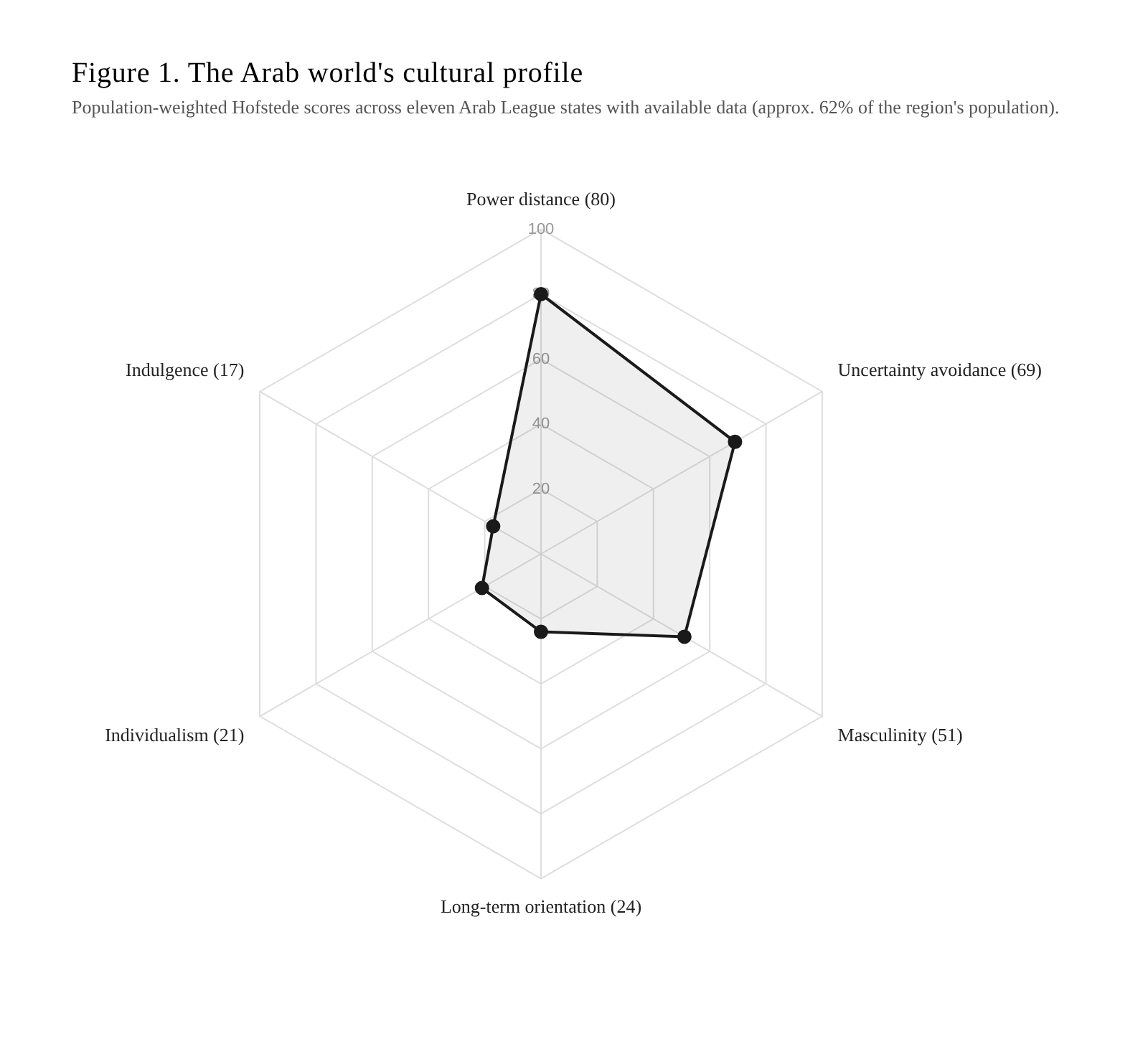
Read as a whole, this describes a cultural configuration in which hierarchy is accepted and expected, ambiguity is uncomfortable, loyalty and mutual obligation run deep, tradition outranks strategic adaptation, and gratification is restrained. Very high power distance together with high uncertainty avoidance points to an environment that prefers defined hierarchies, structured authority and established procedure. High power distance together with strong collectivism points to loyalty, mutual obligation and deference inside hierarchical structures.
That is the profile that the previous five chapters have been showing you in human form: the guest on our head, the manager’s task that takes precedence automatically, the desperate wish for someone to explain the unwritten rules.
And now the problem
Look at the range inside those averages:
- Power distance: 62 in Lebanon to 100 in Libya — a 38-point spread
- Uncertainty avoidance: 55 in Egypt to 96 in Iraq — 41 points
- Long-term orientation: 11 in Iraq to 51 in Qatar — 40 points
- Indulgence: 0 in Egypt to 74 in Libya — 74 points
Seventy-four points. On that dimension, the “Arab average” describes almost nobody.
There is a further distortion. Five countries — Egypt, Algeria, Iraq, Morocco and Saudi Arabia — make up roughly 87% of the population in the eleven-country dataset. The regional average is therefore mostly a portrait of those five, with Lebanon, Jordan, Kuwait, Qatar, Libya and the UAE nearly invisible inside it, and eleven Arab League states missing altogether for lack of data.
Hofstede himself surveyed seven states — Egypt, Iraq, Kuwait, Lebanon, Libya, Saudi Arabia and the UAE — and the resulting scores were then applied to all twenty-two. He explicitly treated the region as a single cultural unit. That aggregation obscures substantial variation in historical experience, political systems, economic development, religious composition and everyday practice.
The Gulf states were shaped by petroleum wealth, rapid modernization, and conservative religious and customary norms. Levantine societies are religiously diverse, with histories running through Ottoman rule and French control. North African societies carry Mediterranean characteristics and French, British and Italian colonial legacies. Islam is the predominant faith, but there are significant Christian minorities in Egypt, Syria, Lebanon, Iraq and Palestine — Coptic, Greek Orthodox, Chaldean, Maronite — and Muslim Arabs are themselves divided between Sunni and Shia. Dimensional frameworks quantify culture and set religion aside; these differences do not disappear because a model has no column for them.
Nor do national borders behave the way the model assumes. Cultural communities live across more than one state — the Nubian community spans Egypt and Sudan — and, as critics of the framework have long argued, national boundaries do not equate with cultural boundaries.
The danger with a name
Cultural essentialism is the attribution of fixed, homogeneous cultural characteristics to national or ethnic groups. It treats culture as deterministic: a core trait you receive by belonging, rather than a dynamic system of meanings that people actively construct and negotiate. Essentialist thinking generates stereotyped expectations, erases individual capacity, and hardens assumptions that were never true in the first place.
Reducing complex cultural systems to scores on a handful of immutable dimensions invites exactly that error — treating culture as a fixed attribute that mechanically dictates behaviour. It ignores that a single culture manifests differently by context, and that individuals do not express their heritage consistently at all times. A person may behave collectively in family settings and individually at work. Dimensions describe contextual repertoires. They do not assign fixed traits.
There is also a political edge to this, and it should be named. Essentialist readings produce loaded comparisons between Western and non-Western cultures, in which one side is modern, egalitarian and progressive and the other traditional, hierarchical and resistant to change. When a framework scores Arab societies high on power distance and uncertainty avoidance, those numbers can be read straight into a stereotype of rigid, authoritarian societies. Responsible cross-cultural work resists reading dimensional profiles as cultural essences and treats them as probabilistic tendencies requiring contextual interpretation and individual verification.
And the variation is not only regional. Arab immigrants arrive in Canada through different pathways — economic immigration, family reunification, refugee resettlement — from different homelands, with different educational and professional backgrounds, at different stages of life. Christian Lebanese immigrants, Syrian refugees, Egyptian professionals and Moroccan students bring different orientations. The composition of Canada’s Arab population has itself shifted, from earlier waves dominated by Christian Lebanese immigrants to more recent arrivals including Muslim refugees from conflict-affected regions. Add generation, age at migration, length of residence, and gender — which dimensional models routinely ignore, and which shapes acculturation profoundly, especially for women with children — and the single label starts to look very thin.
How this study stayed honest
I used Hofstede’s dimensions here as sensitizing concepts, not as measuring instruments. They tell you where to look. They do not tell you what you will find.
The qualitative design was chosen precisely because it can register individual variation, contextual factors, and the meanings participants attribute to their own cultural identity. The interviews invited people to describe their cultural self-understanding in their own words rather than handing them predetermined categories to tick. In analysis I looked for anomalies and within-group variation instead of chasing only the patterns that confirmed dimensional expectations. The theoretical framework treats cultural dimensions as interpretive guides, not deterministic predictors.
This is why the book keeps saying the participants, several participants, a recurring pattern, rather than Arabs. Fourteen people cannot stand in for the more than 450 million people of the Arab world, and they are not being asked to.
What they can do is show you, with unusual precision, how cultural values behave when they walk into a Canadian workplace and start doing a job. That is the evidence. The next part of the book is about what organizations should do with it.